
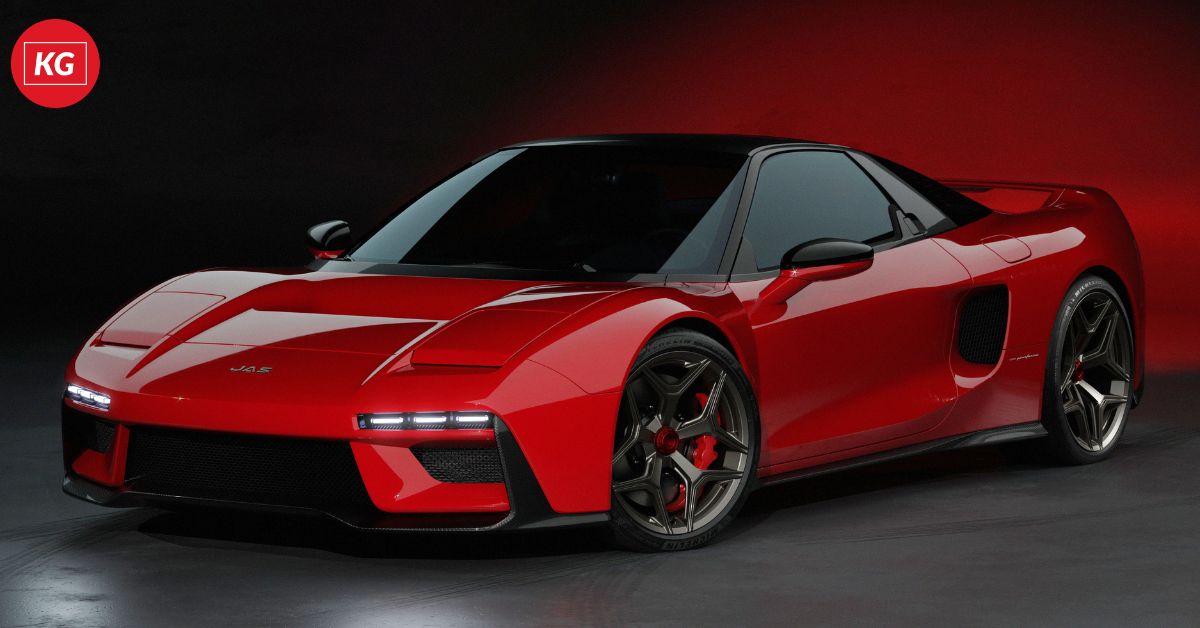
In 1984, a Radical concept car called the HP-X (Honda Pininfarina X) was unveiled at the Turin Motor Show. It was the spark that eventually ignited the fire of the original Honda NSX. Now, forty-two years later, that creative circle has finally closed. Unveiled at Milan Design Week 2026, the Pininfarina NSX Tensei is not just a restomod; it is a “rebirth” (the literal translation of the Japanese word Tensei) of the most influential supercar of the 90s.
Developed in collaboration with JAS Motorsport—Honda’s long-standing racing partner in Italy—the Tensei is a love letter to the “analog” era, written with the high-tech ink of 2026.
1. Design: The Ghost in the Machine
Pininfarina is the master of “invisible” evolution. At first glance, the Tensei is unmistakably an NSX. But as you walk around it, you realize every single line has been sharpened.
The car has been reimagined with a full carbon-fiber body, allowing for tighter tolerances and more aggressive surfacing than the original aluminum skin ever could.
- The Stance: It features a longer wheelbase and a significantly wider track, giving it a “slimmer yet thicker” profile that rivals modern Ferraris.
- Modern Nostalgia: In a move that has enthusiasts cheering, the Tensei retains the integrated rear wing and the silhouette of the pop-up headlights, though they’ve been replaced by sleek, ultra-slim LED units that mimic the original’s hidden look.
- Aerodynamics: The rear overhang has been shortened, and a massive integrated diffuser ensures the car is “sucked” to the ground without the need for unsightly tacked-on wings.
2. A Mechanical Soul: No Turbos, No Hybrids
In an era where every supercar is gravitating toward heavy hybrid batteries and silent electric motors, the Tensei makes a defiant stand.
Under the glass hatch sits a naturally aspirated V6, built upon the architecture of the original Honda C30A/C32B engine. JAS Motorsport has poured decades of GT3 and Touring Car expertise into this block. While final power figures are still guarded, the redline is rumored to be north of 9,000 rpm.
The most important detail? It is paired exclusively with a six-speed manual gearbox. There are no flappy paddles here. The Tensei is designed for the driver who wants to feel the mechanical click of a gear gate and the linear, screaming crescendo of a VTEC-inspired V6.
3. The “Human-Centric” Cockpit
The original NSX was famous for its “fighter jet” visibility and ergonomic simplicity. Pininfarina has doubled down on this “Human-Centric” philosophy for the Tensei interior.
The cabin is a masterclass in tactile luxury:
- Minimalist Tech: You won’t find a 20-inch touchscreen here. Instead, there is a focus on high-quality switchgear, machined aluminum, and bespoke upholstery.
- Enhanced Visibility: By utilizing modern materials for the pillars, Pininfarina has managed to make the cabin feel even more airy than the original, ensuring the driver has a perfect view of the apex at all times.
- Bespoke Tailoring: Every Tensei will be hand-assembled at JAS Motorsport’s Atelier in Arluno, Italy, with owners invited to Cambiano to customize every stitch and surface through Pininfarina’s personalization program.
The Verdict: The Thinking Enthusiast’s Supercar
The Pininfarina NSX Tensei arrives at a perfect moment. As the automotive world reaches “peak digital,” there is a growing hunger for cars that offer a visceral, physical connection.
This isn’t a car built to win a “spec sheet” war against 1,000-hp EVs. It’s a car built to win the battle for your soul on a winding mountain pass. It honors the precision of Japanese engineering and the passion of Italian design, proving that some legends don’t just age—they evolve.














Leave a Reply