
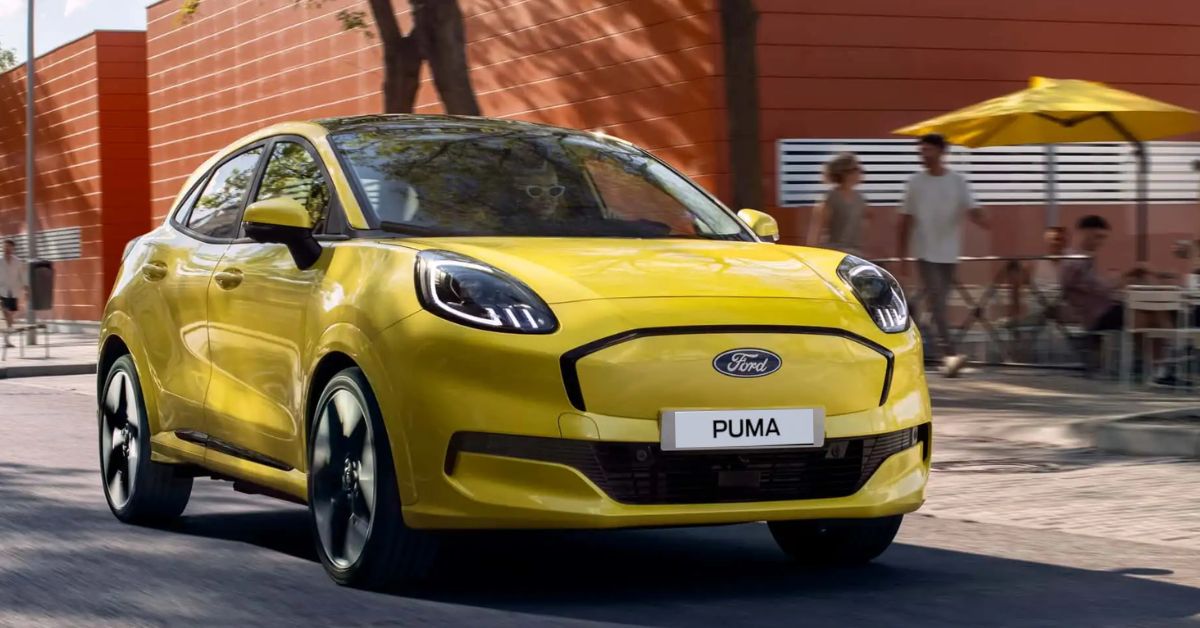
Ford’s all-electric Puma Gen-E has quickly become one of Europe’s most popular compact SUVs, but like many first-generation EVs, it had one major weakness: limited driving range. Now, Ford has addressed this issue head-on with the 2026 Puma Gen-E update, delivering more miles per charge, enhanced driver-assistance features, and a package that makes the small SUV even more compelling for everyday drivers.
🌍 The Puma Gen-E Story
The Puma nameplate has an interesting history. Originally launched as a sporty coupe in the late 1990s, it was reborn in 2019 as a compact crossover. In 2024, Ford introduced the Puma Gen-E, its first fully electric version, produced at the Craiova plant in Romania. The EV quickly became a hit, especially in the UK, where the Puma is the best-selling car.
Demand for the Gen-E was so strong that Ford had to accelerate the updated model’s arrival, keeping the starting price at £26,245 while adding significant improvements.
🔧 What’s New in the 2026 Puma Gen-E?
Ford’s engineers focused on fixing the car’s biggest weakness—range. The updated model now offers:
- 400 km (249 miles) WLTP range, up from 376 km.
- Up to 550 km (342 miles) in urban driving, thanks to optimized battery design.
- BlueCruise hands-free driving technology, allowing semi-autonomous highway cruising.
- Improved efficiency with better battery management and software updates.
These upgrades mean drivers won’t need to charge as often, making the Puma Gen-E more practical for long trips and daily commutes alike.
⚡ Performance and Driving Experience
The Puma Gen-E retains its fun-to-drive character, a hallmark of the Puma lineup. With instant torque from its electric motor, the SUV feels lively in city traffic and confident on highways. The addition of BlueCruise enhances convenience, letting drivers experience hands-free driving on approved motorways.
Ford has also fine-tuned the suspension and steering to ensure the Gen-E remains agile, reinforcing its reputation as a small SUV that’s enjoyable behind the wheel.
🛋️ Design and Comfort
Visually, the Puma Gen-E continues with its sporty crossover styling, but subtle tweaks improve aerodynamics and efficiency. Inside, the cabin features:
- Digital cockpit with large infotainment display.
- Smartphone integration and connected services.
- Comfortable seating and practical cargo space, making it family-friendly.
Ford’s focus has been on blending everyday usability with modern EV technology, ensuring the Gen-E appeals to both first-time EV buyers and seasoned enthusiasts.
📊 Market Position and Competition
The Puma Gen-E competes in the crowded compact EV crossover segment, going head-to-head with rivals like the Peugeot e-2008, Vauxhall Mokka Electric, and Hyundai Kona Electric. With its updated range and competitive pricing, the Puma Gen-E now matches or exceeds many of these competitors.
Strong leasing deals and government EV grants (like the UK’s £3,750 incentive) have further boosted demand. Ford’s strategy of keeping the price steady while improving the product is a clear attempt to dominate this segment.
🔮 The Road Ahead
Ford’s decision to fix the Puma Gen-E’s range issue shows its commitment to listening to customers. By enhancing battery performance and adding semi-autonomous driving tech, Ford is positioning the Puma Gen-E as a mainstream EV choice rather than a niche experiment.
Looking forward, Ford is expected to continue refining its EV lineup, with more models adopting similar battery optimizations and driver-assistance features. The Puma Gen-E’s success could serve as a blueprint for Ford’s broader electrification strategy in Europe and beyond.
✨ Conclusion
The 2026 Ford Puma Gen-E is proof that automakers can evolve quickly to meet customer expectations. By fixing its biggest weakness—range—Ford has transformed the Puma Gen-E into a well-rounded, practical, and fun-to-drive EV. With 400 km WLTP range, BlueCruise technology, and competitive pricing, it’s now one of the most attractive options in the compact electric SUV market.
For buyers, this means fewer charging stops, smarter driving, and a car that truly delivers on the promise of electric mobility. For Ford, it’s a major step toward solidifying its place in the EV revolution.

Leave a Reply