
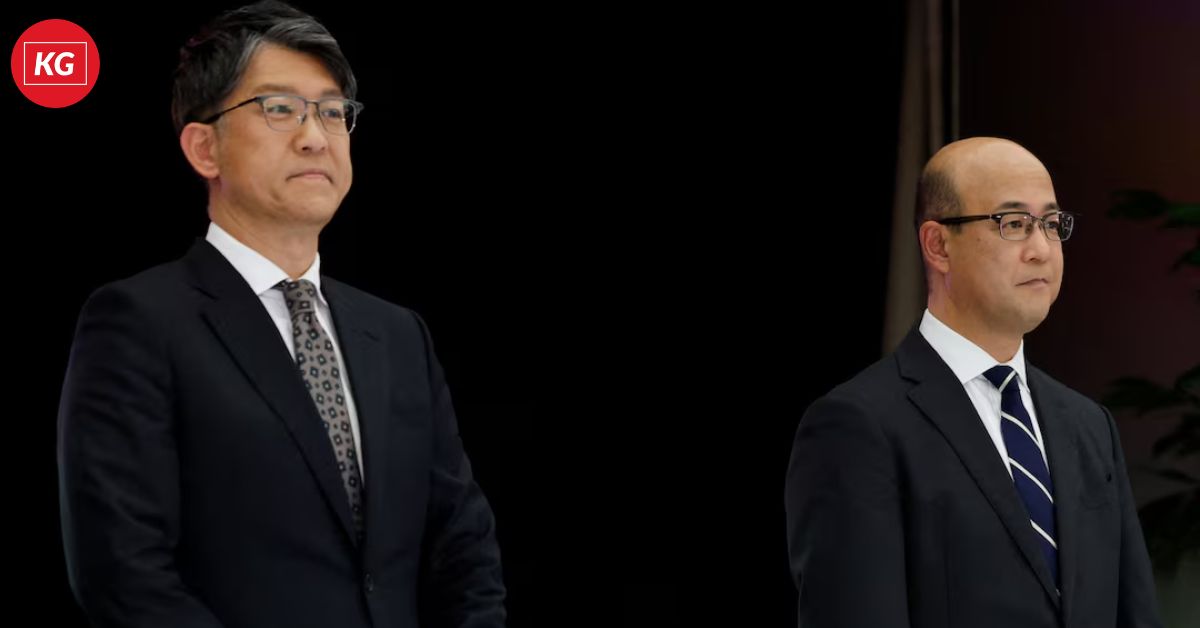
The automotive world held its collective breath today as Kenta Kon, the newly minted CEO of Toyota Motor Corporation, delivered his first-ever earnings report since taking the helm on April 1, 2026. Stepping into the shoes of Koji Sato during a period of intense geopolitical volatility, Kon—a veteran “numbers man” and former CFO—presented a set of results that reflected both the immense scale of Toyota and the crushing weight of global trade tensions.
The headline was a study in contrasts: while Toyota continues to move metal at a record pace, the “Trump Tariffs” of 2025 and 2026 have begun to take a significant bite out of the bottom line.
The Numbers: Hybrid Success Meets Tariff Headwinds
For the fiscal period ending March 31, 2026, Toyota reported a 43% drop in quarterly profit compared to the same period last year. Despite this, the company’s revenue remains remarkably robust, climbing to 38 trillion yen ($242 billion)—a 7% year-on-year increase.
The discrepancy between soaring sales and falling profits can be summed up in one word: Tariffs.
Toyota estimates that recent trade barriers—specifically the 15% tariff on Japanese-built vehicles exported to the U.S. and the threat of 25% levies on EU imports—erased a staggering 1.45 trillion yen ($9.2 billion) from its operating profit over the last year.
- Global Sales: 7.3 million vehicles (Up from 7.0 million)
- Net Income: 3.03 trillion yen (Down from 4.1 trillion)
- Operating Margin: Under pressure as production costs rise alongside trade duties.
The “Kon Doctrine”: Efficiency as a Defense
Kenta Kon is not your typical “car guy” CEO. Unlike his predecessors, Akio Toyoda and Koji Sato, who hailed from engineering and racing backgrounds, Kon is an expert in financial discipline. His appointment was a signal to the markets that Toyota is entering a “fortress” phase—prioritizing profitability and a bulletproof balance sheet over raw volume expansion.
In his address to investors, Kon was characteristically blunt. He noted that while Toyota’s workforce is peerless in quality, they must become “more nimble.”
“My role is establishing a profit structure so that our people can take on courageous challenges,” Kon stated. “We are entering a phase where we will pursue improved productivity, even greater quality, and affordability in our carmaking to offset external pressures we cannot control.”
Kon’s strategy involves a ruthless look at the value chain. By lowering the break-even volume—the number of cars Toyota must sell to cover its costs—Kon hopes to insulate the company from the “tariff-induced” volatility that is currently rocking the industry.
The Hybrid Advantage in a High-Cost World
One of the bright spots in Kon’s report was the continued dominance of Toyota’s hybrid lineup. As competitors struggle with cooling demand for pure EVs and the high costs of battery raw materials, Toyota’s “multi-pathway” approach is paying dividends.
The Lexus brand and the Toyota Crown series have seen record-high margins, helping to cushion the blow of the tariffs. By leaning into hybrids, Toyota is able to maintain higher price points with lower production complexity compared to full-scale electrification, providing Kon with the “dry powder” he needs to reinvest in future tech like solid-state batteries and software-defined vehicles.
Strategic Pivot: Localizing for Survival
The most significant takeaway from the earnings call was Kon’s hint at further localization. To bypass the mounting tariffs, Toyota is accelerating its investment in North American manufacturing.
Following the $10 billion commitment made in late 2025, Kon suggested that more production of high-margin SUVs and Lexus models could shift from Japan to plants in Kentucky and Indiana. While this involves high upfront capital expenditure, it is a defensive necessity in an era of “America First” trade policies.
The Road Ahead
Kenta Kon’s first outing as CEO has proven that he is the right leader for a “siege economy.” He isn’t interested in the glamour of the track; he’s interested in the resilience of the ledger.
However, the road ahead remains uphill. With global supply chains still fragile and the potential for retaliatory tariffs from the EU, Kon’s “financial fortress” will be tested. For now, investors seem to trust the architect. Toyota’s stock jumped 2% following the announcement—a rare sign of confidence in a market defined by uncertainty.













Leave a Reply