
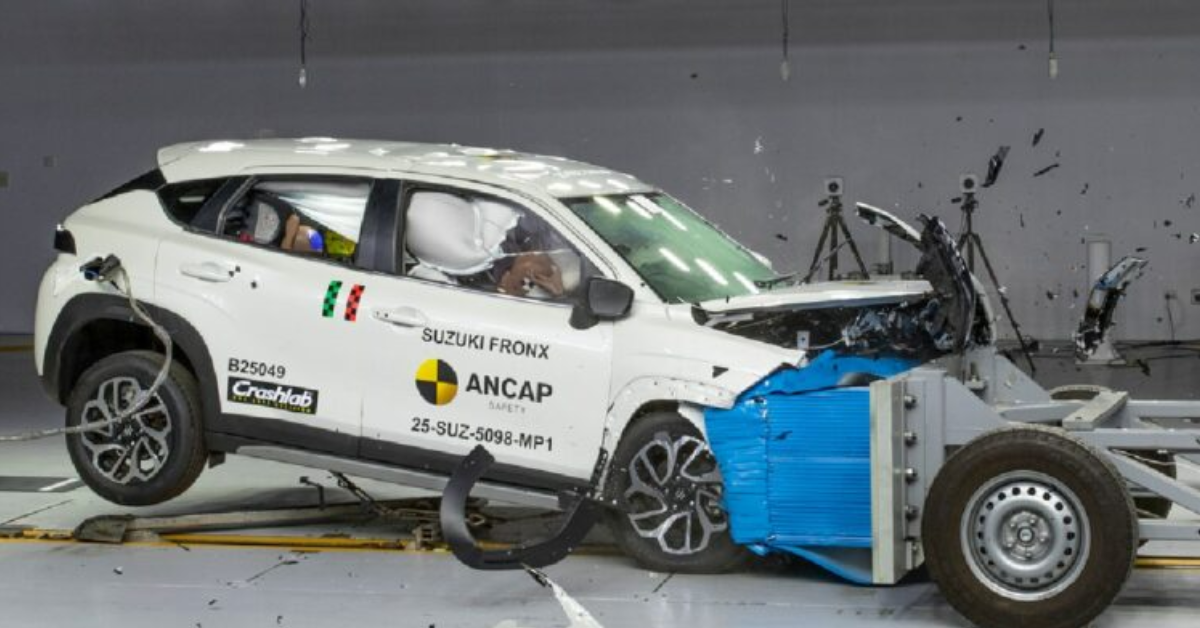
The Made-in-India Maruti Suzuki Fronx has encountered a significant challenge on the global stage after struggling in ANCAP safety testing, reportedly due to seatbelt performance issues. The development has sparked widespread discussion around vehicle safety standards, export quality, and the growing scrutiny faced by Indian-manufactured cars in international markets.
As Indian automakers expand their footprint across global markets, safety ratings from agencies like ANCAP play a critical role in shaping consumer trust and brand credibility. The Fronx’s performance highlights the increasing importance of robust safety engineering in meeting international expectations.
What Is ANCAP and Why It Matters
ANCAP, or the Australasian New Car Assessment Program, is one of the most respected vehicle safety assessment bodies in the world. Its crash tests evaluate occupant protection, safety assist technologies, and structural integrity under real-world conditions.
A strong ANCAP rating often translates into higher consumer confidence, better resale value, and stronger brand positioning in safety-conscious markets such as Australia and New Zealand. Conversely, a weak or compromised result can impact a vehicle’s reputation far beyond the region where it is tested.
The Core Issue: Seatbelt Performance
According to reports, the Maruti Fronx faced difficulties during ANCAP evaluation due to seatbelt-related concerns, which affected occupant protection scores. Seatbelts are a fundamental safety component, designed to restrain occupants during frontal and side impacts.
In modern crash assessments, even minor shortcomings in restraint systems—such as load limiters, pretensioners, or belt geometry—can significantly affect injury readings. The reported issue underscores how critical fine-tuned safety systems are in achieving high ratings.
Why Seatbelts Are Critical in Crash Tests
Seatbelts work in conjunction with airbags, crumple zones, and vehicle structure to minimize injury. In crash testing, agencies closely analyze:
- Chest and head impact forces
- Belt load distribution
- Timing of pretensioners
- Interaction between seatbelts and airbags
Any inconsistency can lead to higher injury values, resulting in reduced safety scores. The Fronx’s struggle in this area suggests the need for further optimization to meet stringent global benchmarks.
Impact on Maruti Suzuki’s Global Ambitions
Maruti Suzuki has been aggressively expanding exports from India, positioning the country as a global manufacturing hub. Models like the Fronx are key to this strategy due to their competitive pricing, fuel efficiency, and modern design.
However, international safety performance is increasingly non-negotiable. A weaker ANCAP outcome could prompt the company to revisit safety configurations for export markets, especially where consumers place a premium on crash-test ratings.
Indian Cars Under Global Safety Lens
Indian-made vehicles are no longer confined to domestic roads. As they enter developed markets, they face stricter safety expectations than ever before. This shift has placed immense pressure on manufacturers to align local production with global safety norms.
The Fronx episode serves as a reminder that cost optimization must not compromise safety engineering, especially when competing internationally. It also highlights the growing maturity of Indian manufacturing, where transparency and continuous improvement are essential.
Domestic vs Export Specifications
One key discussion point arising from this issue is the difference between domestic and export specifications. Vehicles sold in India often prioritize affordability, while export variants may require additional safety reinforcements.
Manufacturers may now need to standardize higher safety features across all markets to avoid reputational risks. This could lead to increased costs but also elevate overall safety standards for Indian consumers.
What This Means for Buyers
For buyers in international markets, safety ratings remain a critical purchase factor. A compromised ANCAP result could influence purchasing decisions, fleet approvals, and insurance assessments.
For Indian consumers, the situation may prompt questions about safety parity and future updates. While testing protocols differ across regions, global scrutiny often accelerates improvements across all variants.
Potential Manufacturer Response
Automakers typically respond to such outcomes through:
- Technical revisions to restraint systems
- Software recalibration for airbags and pretensioners
- Structural reinforcements
- Improved safety feature standardization
Maruti Suzuki is expected to analyze the findings closely and implement corrective measures to enhance the Fronx’s safety performance in future assessments.
Regulatory and Industry Implications
As safety agencies worldwide tighten testing protocols, manufacturers must adapt quickly. The Fronx’s experience reflects a broader industry trend where even popular, well-selling models are not immune to safety criticism.
This could encourage stronger collaboration between regulators, manufacturers, and suppliers to ensure globally competitive safety performance from Indian-made vehicles.
Balancing Cost, Volume, and Safety
One of the biggest challenges for mass-market automakers is balancing affordability with safety excellence. While adding advanced restraint systems increases costs, failing to meet safety expectations can be far more damaging in the long run.
The Fronx’s ANCAP struggle illustrates how safety has become a defining factor—not an optional feature—in modern automotive success.
Conclusion
The Made-in-India Maruti Fronx’s struggle at ANCAP due to seatbelt-related issues marks a critical moment for both the model and India’s automotive export ambitions. While the vehicle offers strong design, efficiency, and value, global markets demand uncompromising safety performance.
This development serves as a wake-up call for the industry, reinforcing that safety engineering must evolve alongside styling and technology. As Indian automakers aim for global recognition, meeting international safety benchmarks will be essential to sustaining long-term growth and trust.






Leave a Reply