
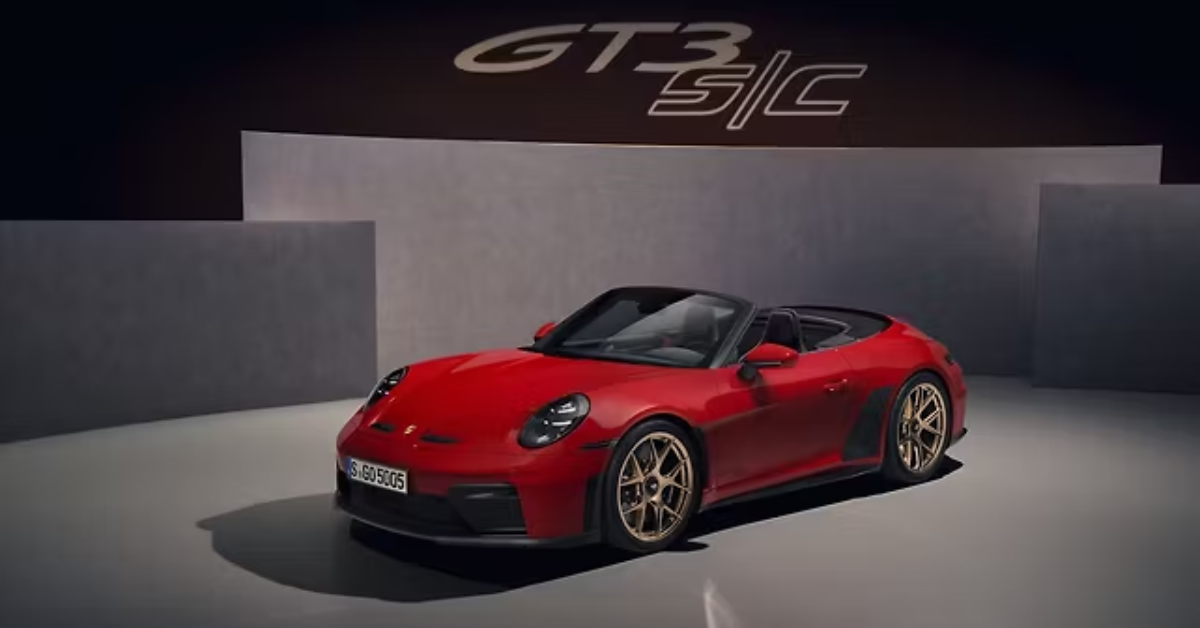
Few cars in the world carry the legacy, emotion, and engineering precision of the Porsche 911 GT3. It’s a machine that has long been celebrated for its raw, naturally aspirated engine, razor-sharp handling, and an uncompromising connection between driver and road.
Now, imagine introducing a new version—the Porsche 911 GT3 S/C—that builds on this legacy but takes a slightly different path. On paper, it makes perfect sense. It enhances performance, improves usability, and embraces modern technology. But for purists, it raises an uncomfortable question:
Has the GT3 become too refined for its own identity?
This blog explores why the GT3 S/C is a logical evolution—and why it might not sit well with traditional enthusiasts.
What Does “S/C” Really Mean?
The “S/C” badge hints at a shift in philosophy.
Traditionally, the GT3 has been known for its naturally aspirated engine—a rarity in today’s turbocharged world. The S/C variant suggests a move toward either supercharging or a more performance-focused configuration, aimed at extracting even more power and efficiency.
From a technical standpoint, this evolution makes sense:
- Higher power output
- Improved torque delivery
- Better acceleration
But emotionally, it changes the character of the car.
Key Conflict:
Performance improves, but purity may be compromised.
Performance Gains: Undeniably Impressive
Let’s address the obvious—the GT3 S/C is faster.
Expected Performance Improvements
- Increased horsepower and torque
- Quicker 0–100 km/h times
- Stronger mid-range acceleration
- Enhanced track performance
The addition of forced induction (if applied) or advanced tuning allows the engine to deliver power more efficiently across the rev range.
For most drivers, this is a win.
You get:
- Faster lap times
- Better overtaking capability
- More accessible performance
But for purists, speed is not everything.
The Purist Perspective: Why It Matters
To understand the controversy, you need to understand what makes the GT3 special.
It’s not just about numbers—it’s about:
- High-revving naturally aspirated engine
- Linear power delivery
- Mechanical feedback
- Driver engagement
These elements create a driving experience that feels raw and authentic.
Introducing changes that alter this formula—even if they improve performance—can feel like a betrayal to long-time fans.
The Purist Argument:
“If it’s not broken, why fix it?”
Driving Experience: Sharper or Softer?
The GT3 S/C is likely to offer a more refined driving experience.
What’s Improved
- Better traction and stability
- More predictable power delivery
- Enhanced electronic aids
- Improved comfort for daily use
These upgrades make the car more approachable and usable.
What Might Be Lost
- Raw edge
- Mechanical feel
- High-revving drama
The traditional GT3 demands skill and rewards precision. The S/C version may reduce that challenge, making it easier to drive fast—but potentially less thrilling.
Technology Integration: Necessary Evolution
Modern performance cars are increasingly defined by technology.
The GT3 S/C is expected to feature:
- Advanced driver assistance systems
- Improved traction control
- Enhanced infotainment
- Digital interfaces
From a usability standpoint, this is a clear improvement.
Drivers benefit from:
- Better safety
- Easier daily driving
- More convenience
However, technology can also create distance between the driver and the car.
The Trade-Off:
Convenience vs connection.
Design Philosophy: Subtle but Purposeful Changes
Visually, the GT3 S/C is unlikely to stray far from its iconic design.
However, expect:
- More aggressive aerodynamics
- Functional enhancements for cooling and airflow
- Subtle styling updates
These changes are not just aesthetic—they’re performance-driven.
But even here, some enthusiasts may feel that the design is becoming too engineered and less organic.
Everyday Usability: A Big Win
One area where the GT3 S/C clearly excels is usability.
Traditional GT3 models are:
- Stiff
- Loud
- Demanding
The S/C version aims to address these limitations.
Improvements Include
- Better ride comfort
- More manageable power delivery
- Enhanced practicality
This makes the car more appealing to a wider audience.
For many buyers, this is a major advantage.
Market Reality: Why Porsche Had to Do This
From a business perspective, the GT3 S/C makes perfect sense.
The automotive world is changing:
- Emission regulations are tightening
- Buyers expect more technology
- Competition is increasing
To stay relevant, even iconic models must evolve.
The GT3 S/C allows Porsche to:
- Meet modern standards
- Attract new customers
- Maintain performance leadership
Reality Check:
Cars must evolve to survive.
The Enthusiast Divide
The GT3 S/C creates a clear divide between two types of buyers.
Modern Performance Buyers
- Appreciate technology
- Value usability
- Want maximum performance
Traditional Purists
- Value raw driving feel
- Prefer simplicity
- Resist major changes
Both perspectives are valid, but they lead to very different expectations.
Is This the Beginning of a New GT3 Era?
The GT3 S/C could signal a broader shift.
If successful, it may lead to:
- More technologically advanced GT models
- Greater focus on usability
- Further departure from traditional formulas
This raises an important question:
Will future GT3s prioritize performance over purity?
What Porsche Gets Right
Despite the controversy, Porsche deserves credit for several things:
- Continuing to innovate
- Balancing performance and usability
- Adapting to changing market demands
The GT3 S/C is not a step backward—it’s a step forward, just in a different direction.
What Might Be Lost
At the same time, something intangible may be at risk:
- Emotional connection
- Mechanical simplicity
- The thrill of mastering a challenging car
These are the qualities that made the GT3 legendary.
Final Thoughts
The Porsche 911 GT3 S/C is a fascinating example of how even the most iconic cars must evolve.
It makes perfect sense:
- It’s faster
- More usable
- More advanced
But it also challenges tradition.
For new buyers, it’s likely to be a dream machine—combining performance and practicality in a way few cars can match.
For purists, however, it may feel like the end of an era.
And that’s the real story here.
The GT3 S/C is not just a new version of a car—it’s a reflection of where the automotive world is heading.
A world where performance is enhanced by technology, usability is prioritized, and even legends must adapt.
Whether you see that as progress or compromise depends entirely on what you value most in a driving experience.













Leave a Reply